Special Feature Learning
September 14, 2026

Curious about coding? 5 tips to get started

From solving biological puzzles to making sense of enormous datasets, coding has become mainstream in modern science. As we generate more data than ever before, the ability to analyse, explore and interpret this treasure trove of information is becoming an essential skill. But for those new to programming, the prospect of tackling a command line can still feel daunting.

Biology is now a data-rich science. Decades of advances in sequencing and technology mean researchers are generating vast amounts of information to decode and understand the complex world around us.

Making sense of this wealth of data has also brought about significant developments in bioinformatics and computational biology, where coding is used to search and analyse, map patterns, test ideas, and even model how different organisms could adapt.

At its simplest, coding is writing instructions that tell a computer system what to do. There are many programming languages, including (but not limited to!) Python, Java, C++, and R, and different languages and tools will be suited to different questions and projects.

And similarly careers in coding also vary, from research software engineers, computational biologists and bioinformaticians, to app developers and system architects - coding can form a small part, or even the entirety of a scientist's role.

As National Coding Week aims to encourage people of all ages to develop their digital skills, we asked computational scientists at Earlham Institute what coding means to them – and what advice they would give to anyone thinking about delving into this world.


1. You don’t need to be good at maths

Logical thinking and creativity are key!

“People often believe that you have to be amazing at difficult maths. You don’t. It’s more about problem-solving and logic/reasoning, and learning to code can actually help you get better at both those things,” explains Dr Rowena Hill, Postdoctoral Researcher in fungal genomics at Earlham Institute.

“Unless you are working on problems that require complex maths, it’s absolutely not a prerequisite,” adds Dr Gurpinder Singh Sidhu, Postdoctoral Researcher in the Haerty Group. “Logical thinking, creative problem solving and a willingness to experiment are much more important skills.”

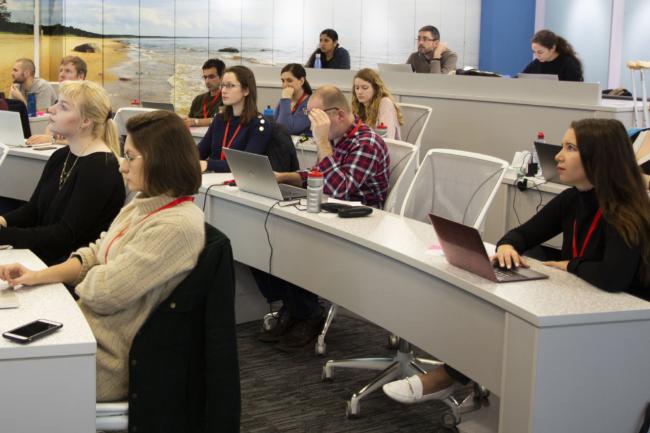
Bioinformatician Gillian supports delegates during a python training course

2. Find a reason to code

Don’t code in isolation - identify a purpose, a project, or a question to answer, which will help frame your coding journey.

“You can learn some of the basics first, but to address your reason to code you’re going to have to learn to think like a programmer and that’s where the real challenge and value in coding is. It’s far more fun doing this when you’ve got something in mind you want your code to solve,” explains Dr Gillian Reynolds, Senior Bioinformatician in our Core Bioinformatics Group.

"Coding is a tool to achieve a goal - think of something that you really want to create, could be anything from a simple program to automate something on your computer, a website or a game, and then learn what you need as you go,” Gurpinder suggests.

3. Learn by doing, and make mistakes

Coding requires practice, just like anything else in life. 

There is a huge open resource out there to get started with coding. You don’t even need a computer to get started, there are many coding toys out there, where you can learn basic programming and robotics in a fun way. Fundamentally code is telling a computer how to do something and it’s mostly logic. If you like logic based reasoning, such as doing Sudoku puzzles, then code is an easy step,” explains Dr Laura Shemilt, Lead Architect for BioFAIR UK. 

“The best way is to learn by doing,” adds Rowena. “Find a small interactive project online that you can get stuck into. Don’t be disheartened by failure or a steep learning curve – puzzling it out is part of the process,” 

“Find a project that excites you. This will give you the motivation to continue to learn how to implement. AI can now do most of what you need for you, but if you truly want to understand code, start from the basics and write it yourself,” Laura adds.

“Keep going. Write ugly code, write 100 lines of code that could in fact be 10. Have a go and get it wrong. Start again but from a better educated place each time. Remember as Terry Pratchett says, coming back to the same place is not the same as never leaving. Starting again isn’t the same as starting from nothing,” Gill says. 

Scientists taking part in an EI hackathon

4. Coding can change how you think

Coding is not just a string of characters on a screen, it becomes a way of thinking and approaching problems. 

Coding has encouraged me to think more methodically and systematically. It requires you to understand a problem, break it down into smaller, manageable components, and then work through each step logically to arrive at a solution,” says Fred Uche, Research Software Engineer in the Leggett Group.

“I find that this approach translates well to scientific research. When faced with a scientific question, I tend to first understand and define the problem clearly, consider the available data and evidence, break the question into smaller parts, and then evaluate possible approaches before developing a solution,” he adds.

A sentiment echoed by Gill: “I approach every question through the lens of an algorithm developer and data scientist. I think about how I would use code to solve the problem in front of me, she says. “How am I going to ask the computer to handle the files? What if they’re really large and numerous? Which is the most memory efficient structure and which can I search fastest? What am I trying to analyse in the file? What are the trade-offs with my approaches and are they acceptable to everyone involved?

Gurpinder leads a training session on coding

5. It's interesting!

Coding opens up a whole new world of learning and discovery.

"My favourite thing is the breadth of biological problems I get to work on, from crops and medicine to fundamental biology. It’s made me comfortable with not having all the answers, and excited to learn from people with different expertise. There’s always something new to learn, and that keeps things interesting for me," says Gurpinder.

“I enjoy seeing how computing can be used to solve real biological challenges, making complex data more accessible, structured, and useful for researchers,”  adds Fred. “It’s particularly rewarding to build tools that help scientists manage, analyse, and share data, ultimately enabling better and more reproducible research.”

“The never ending stream of ideas from getting to work spanning my two favourite subjects. I love that I can think of an idea and do a quick test in a matter of hours to days,” Gill adds.