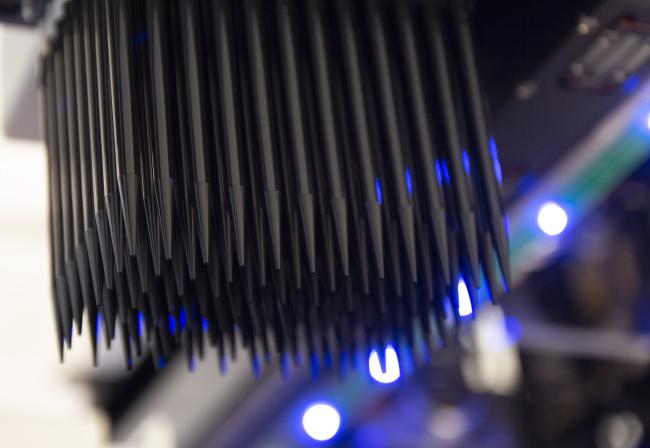
Part of Eleonora’s work relies on the BioLector, a high-throughput automated microfermentation platform. Capable of growing up to 48 microbial cultures in parallel on a microscale, it allows her to evaluate the performance of different combinations of strains and media types in a single experiment. By increasing throughput, it accelerates screening time from months to weeks, while miniaturising the culture volume saves money by dramatically reducing the quantity of growth medium, antibiotics, reagents and lab space needed.
Another critical feature of the BioLector is its ability to continuously monitor and record multiple key parameters in real time, such as biomass, oxygen, pH and the production of recombinant protein.
“Not only does this automation free up valuable scientist time by eliminating the need for slow, manual sampling,” says Eleonora, “it captures far more data in a single run than a person ever could. This gives our industry partners a much deeper understanding of the bioprocesses they’re developing and allows them to optimise growth conditions before moving to expensive, larger-scale production.”
As one of the best-equipped BioLector platforms in the UK, the system significantly expands the range of applications the team can undertake. Its advanced gassing capabilities tightly regulate oxygen and carbon dioxide levels, closely mimicking industrial bioreactor conditions to reveal how both aerobic and anaerobic microbes behave when grown at scale. This overcomes one of the central challenges in biomanufacturing, where small-scale results often fail to translate to larger cultures due to differences in oxygen transfer, mixing and environmental control.
The system is also fitted with a specialised light array module, making it the only public research facility in the UK capable of testing phototrophic microbes like cyanobacteria and microalgae.