Breaking the silos: How open collaboration is transforming plant pangenomics
Pangenomes are transforming plant genomic research by capturing the vast genetic diversity that traditional, single reference genomes often miss.
At the Earlham Institute, Dr Rachel Rusholme-Pilcher is leading a new international network dedicated to overcoming the computational hurdles of generating plant pangenome graphs, through a culture of openness and collaboration.
Historically, genomic research has relied on the reference genome – a single, well-characterised genome sequence used as a blueprint for an entire species. While this has revolutionised our understanding of biology, its usefulness is significantly limited by ‘reference bias’, its inability to capture genetic variation within a population.
“If a key part is missing from the reference genome, it becomes effectively invisible to researchers," explains Dr Rachel Rusholme-Pilcher, a Senior Postdoctoral Scientist at the Earlham Institute. "For example, wheat cultivars might have large sections of DNA that are missing from a single reference genome. If you’re working on a gene in this missing section, you simply can't see or assess it."
The tide is now turning, however. Advances in long-read sequencing have made it possible to generate high-quality reference genomes for multiple individuals within a species, faster and more cheaply. This has paved the way for the pangenome, a comprehensive collection of genomes that captures the breadth of genetic diversity within a population or species. For plant scientists, this is crucial for identifying genes that can be used to breed more resilient and higher yielding crops in a changing climate.
Rachel began working on plant pangenomes six years ago, when the field was lagging significantly behind pangenome studies in bacteria, humans and other animals. Plant pangenomics is uniquely challenging, partly due to the large size, repetitive nature and the high heterozygosity and ploidy levels of plant genomes. At the Earlham Institute, access to High-Performance Computing (HPC) clusters proved vital for overcoming the massive computational hurdles needed to drive her research forward.
Rachel is now taking tools designed to generate human pangenome reference graphs and applying them to wheat datasets. These graphs act as maps of all known genetic variations within a species. By benchmarking these graph-based references against single reference genomes, she is testing whether the existing tools are sufficient to generate accurate pangenome graphs in wheat. Her ultimate goal is to enable other researchers to build their own plant pangenomes and to catalyse the development of better tools for plant pangenome studies.
Currently, Rachel is focusing on building a pangenome for the Watkins Collection, a historic set of wheat landraces. “The wheat genome is a complex mosaic of introgressions and structural variants that have been shuffled over generations," she explains. “By highlighting areas of variation within the collection, the pangenome can help us attribute specific genomic regions to useful traits like yield, disease resistance, and climate adaptation, providing a wealth of markers to use in wheat breeding programmes.”
![]()
By highlighting areas of variation within the collection, the pangenome can help us attribute specific genomic regions to useful traits like yield, disease resistance, and climate adaptation, providing a wealth of markers to use in wheat breeding programmes.
![]()
Dr Rachel Rusholme-Pilcher
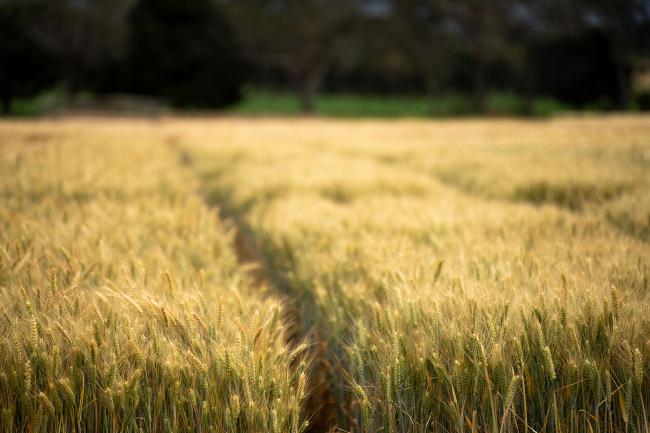
Image: Watkins wheat landraces in the field, ©John Innes Centre, Phil Robinson
In 2025, Rachel and her colleague, Professor Anthony Hall, attended the Plant and Animal Genome (PAG) conference in San Diego. They convened a meeting with other cereal pangenome researchers, only to find a room full of people all facing the same fundamental problems.
"We are all hitting the same issue," Rachel recalls. "We were analysing larger, more complex genomes using tools designed for other organisms and finding that the outputs weren't necessarily representative of what was put in, nor useful for the questions we wanted to ask." Furthermore, there was no recognised standard to assess the quality of a pangenome graph, which risked making the data unusable..
Realising that exchanging experiences was far more efficient than working in silos, they saw an opportunity to accelerate progress by bringing together researchers who were tackling the same problems in different ways. After returning to the UK, Rachel and Anthony reached out to international colleagues to set up a regular forum for discussion. This led to the establishment of the International Plant Pangenome Network (IPPGN).
One year in, the network, chaired by Rachel, has grown to include 38 individuals from 24 institutions, spanning academia, research institutes, tool developers and plant breeding companies. Its main aim is to advance the development of plant pangenome graphical references by sharing knowledge and experiences, and collective problem-solving.

![]()
As an industry scientist, the IPPGN has been an excellent way to stay connected with the broader scientific community and contribute my own learnings outside of more traditional knowledge sharing methods that are less accessible to industry researchers, such as publication.
![]()
Dr Cassandra Wattenburger, Genomics Data Scientist, Bayer Crop Science
The network is built on a core ethos of openness, sharing and collaboration. “Scientists don’t usually talk about what goes wrong,” says Rachel. “But sharing our learnings from what hasn’t worked has been hugely valuable.”
This culture of openness even extends into the naturally competitive side of science. The group operates under an agreement that, if a member wishes to develop an idea raised by someone else, they will approach them for a discussion first. "There’s a lot of trust involved," Rachel says. “But because the group is so effective, we can all see that it’s more valuable to share information than not.”
A key strength of the network is its diverse pool of expertise, spanning different career stages, institution types, disciplines and species specialities. By bridging the gap between computational and biological fields, alongside tool developers and breeding programmes, the group exposes members to a broad range of practical approaches, enabling them to tackle technical challenges from different viewpoints.
Involving the tool developers has been particularly transformative. “The developers were already aware of the challenges we face using their tools for plant genomes,” Rachel notes, “but this has given us the chance to ask questions and find out where they’re heading with future development. We can share feedback on specific hurdles and the developers can suggest new approaches for us to try. It’s been incredibly useful.”
![]()
By connecting researchers who have rich expertise across a diversity of systems, the [International Plant Pangenome] Network has provided me with a one-stop shop for feedback and ideas as I help my local research team address pangenome-level research questions in multiple taxa. The sum of each participant's unique background and experiences is a wealth of perspectives to draw from as we strive to push graph-based methods forward for technically challenging collections of plant genomes.
![]()
Dr Avril Harder, Computational Biologist at the Genome Sequencing Center, HudsonAlpha Institute for Biotechnology
Reflecting on the past year, Rachel acknowledges that it has been a steep learning curve. “It’s the first time I’ve led an international network like this, so I’m essentially learning on the job," she says. "But seeing the benefits of this approach has been extremely rewarding. It’s cemented my belief in how the best science is done – bringing together the right expertise to ensure that our work is connected to applied outcomes."
The Earlham Institute’s strategic focus on data-intensive biology and its commitment to making data accessible provided the ideal environment for the IPPGN to flourish. Rachel was given the institutional backing and freedom to host and organise the group, supported by EI’s open and collaborative research culture.
For scientists looking to unite a similarly fragmented field, Rachel offers a simple but compelling piece of advice: "You have to embrace openness from the start, otherwise it just won't happen," she says. "You need a core group of people who are willing to acknowledge that the science will be better if it's done together and openly. Once you have that foundation of belief, you can begin to draw others in."
Rachel's work on pangenomics in wheat is contributing to the cross-institute Delivering Sustainable Wheat programme, as well as Earlham Institute's Decoding Biodiversity strategic research.
Authored by Dr Mimi Tanimoto, writing for Earlham Institute