Article People

The Making of a Computational Biologist: Dr Graham Etherington

Dr Graham Etherington, senior computational biologist at the Earlham Institute, brings warmth and humour to everything he does. However, behind the smile is a strong determination to succeed which has propelled Graham throughout his career.

24 June 2026

Dr Graham Etherington, senior computational biologist at the Earlham Institute, brings warmth and humour to everything he does. However, behind the smile is a strong determination to succeed which has propelled Graham throughout his career. 

At the age of 17, Graham joined the Royal Air Force, leaving school with two GCSEs. It was during his time in the RAF that something shifted - Graham seized the opportunity to retake his exams, and in doing so, discovered a love of learning he hadn't expected.

When the moment arrived to renew his contract, following 12 years in service, he instead chose to follow that instinct and explore a more academic path. As Graham explains: "I enjoyed doing my exams - I realised the importance and enjoyment of getting an education, and I felt like I wanted to pursue that."

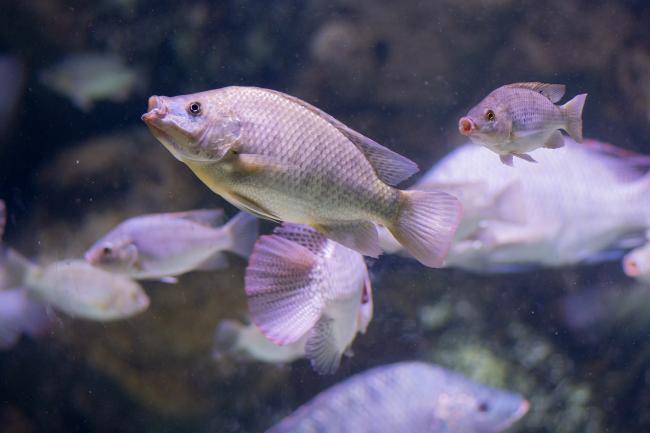
Graham's work explores genomic diversity across a wide range of species, including cichlid fish, yeast, polecats, and ancient wheat
Graham at an open day at Earlham Institute with members of the public

After completing a college access course, Graham followed his passion for nature - as an avid birdwatcher - to pursue a degree in biological sciences at the University of East Anglia. To fund his studies, he gained an HGV licence and worked as a lorry driver during university holidays.

In his penultimate year, Graham was offered the opportunity to study at UC Berkeley. It was here that he discovered his aptitude for bioinformatics:

"My first scientific project as an undergraduate was at Berkeley - a phylogenetics study splitting two species: the hen harrier of Eurasia and the northern harrier of North America. I went round museums measuring specimens and taking notes about their appearance and characteristics, then did sequencing and phylogenetic analysis using computer software. I really enjoyed it. I liked seeing DNA written down in front of me, and it was remarkable what you could find out just by analysing sequences.”

What I love about bioinformatics as a whole is that you can apply it to such a wide range of organisms - no two days are the same. I might be working on wheat one day, hedgehogs the next, polecats the next, yeast the next.

Despite missing opportunities to follow his interests in avian genetics, Graham continued his academic pursuits, gaining a PhD in bioinformatics and a postdoctoral position in Brisbane. Once again, his determination shone through. With his PI leaving after just a few months, Graham found himself largely on his own -  and got on with it: "That experience gave me skills, though - and I think you get skills just by being in a place, even without a PI there to guide you. I taught myself as much as I could. In many ways, I was a self-taught postdoc."

They say that Norwich is the sort of place people always return to, and that has certainly been true for Dr Etherington. Drawn back to the Norwich Research Park, Graham worked first at the Sainsbury Laboratory and then the John Innes Centre, before finding his home at the Earlham Institute in 2014.

"What I love about bioinformatics as a whole is that you can apply it to such a wide range of organisms - no two days are the same. I might be working on wheat one day, hedgehogs the next, polecats the next, yeast the next.”

On life at the Earlham Institute, Graham adds, “I really like working here. People are social, the facilities are great and there are genuinely good opportunities to mould your own path. And when you get stuck, there's always someone you can go to. Even if they don't know the answer, they'll know a bit more than you, and they can point you towards the right resource. It's just a short walk to someone's office - and across this institute, the wealth of experience and knowledge is remarkable."

Today, Graham uses whole-genome sequencing to explore genomic diversity across a wide range of species, including cichlid fish, yeast, polecats, hedgehogs, antelopes, and ancient wheat. From leaving school with two GCSEs to becoming a senior computational biologist, Graham's path has been anything but straightforward. But that, perhaps, is exactly what makes it worth telling. 

I really like working here. People are social, the facilities are great and there are genuinely good opportunities to mould your own path. And when you get stuck, there's always someone you can go to. 

Explore some of Graham's previous research: