




















Image


The Earlham Institute and Natural History Museum, London have today announced a joint venture spin-out company Agnos Biosciences™ and its cutting-edge rapid DNA air sequencing technology, AirSeq™, to transform biological threat detection.
The Agnos Biosciences™ team developed the AirSeq™ technology which provides rapid detection of airborne pathogens, transforming capabilities for early pathogen detection. This new technology is a method for characterising biological particles in the air using a combination of novel molecular biology, DNA sequencing and bespoke computational analysis.
With a very low false positive rate, it can be used to quantify the presence of bacteria, viruses, fungi, pollen or any other biological material. Unlike alternatives, AirSeq™ is unbiased, is not targeted to specific pathogens and can detect multiple (1000s) species.
Culminating years of scientific research and development funded by the Biotechnology and Biological Sciences Research Council (BBSRC), Earlham Institute, NHM and other public and philanthropic funding bodies in the UK and US, AirSeq™ technology has a range of potential applications with proven results in environmental monitoring, agricultural pathogens, food manufacturing - and biological threat detection following extensive research with the US DARPA (United States’ Defense Advanced Research Projects Agency).
Earlham Institute Group Leader and Agnos Biosciences Co-Founder and CTO Dr Richard Leggett said: “I'm delighted to launch AirSeq as a service after so many years of research and development. This is an exciting opportunity to use this technology to help new customers with different applications, as well as develop AirSeq's continued use in agriculture, the wider food industry and in biosecurity.”
At the Earlham Institute scientists have contributed over a decade of research to AirSeq technology.
Natural History Museum Research Leader and Agnos Biosciences’ Co-Founder and CSO Professor Matt Clark said: “AirSeq is the culmination of many years of research. We are very excited about how fast and accurate it is at detecting pathogens or indeed any organism via their DNA – identifying them in the air enables early, critical interventions hopefully preventing infections and pandemics taking hold.”

Research Group Leader and Agnos Biosciences Co-Founder and CTO, Dr Richard Leggett (left) with Earlham Institute's Head of Business Development and Impact Dr Liliya Serazetdinova. Credit: BBSRC/UKRI
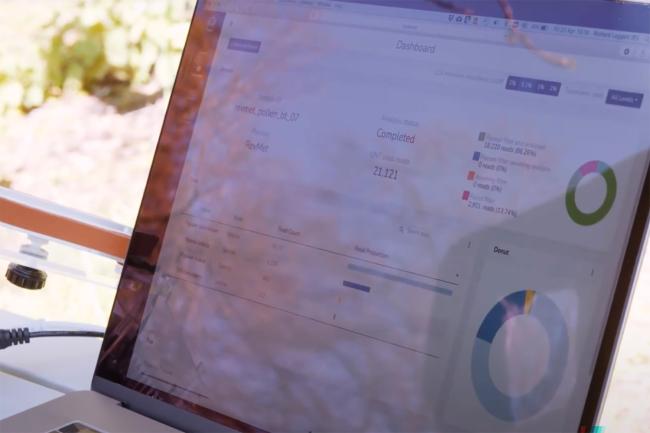
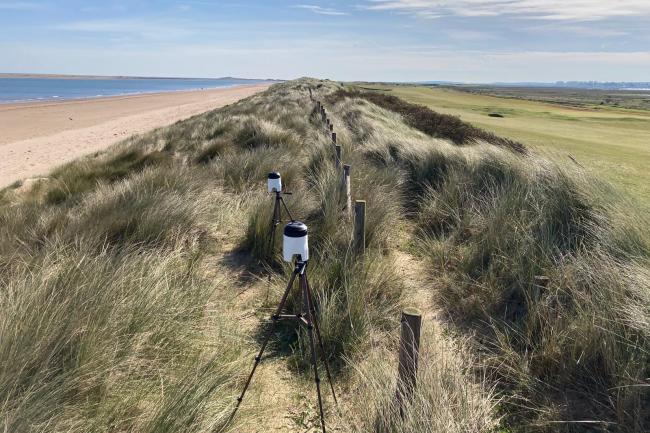
The Earlham Institute and Natural History Museum are licensing AirSeq technology to Agnos Biosciences™ which will enable the spinout to offer it as an end-to-end commercial service includes air sampling, lab-based DNA extraction and sequencing, as well as bioinformatics analysis and web-based visualisation of results.
With the core technology (patented novel molecular biology methods and bioinformatics platform) prototyped, tried and tested, AirSeq™ is already being used by customers in the UK. AirSeq™ has multiple commercial applications from food safety in food manufacturing to cleanroom, controlled environment applications in biopharma to biosecurity and biological threat detection.
The dual-use spinout Agnos Biosciences™ is the first venture to launch from the Strategy and Innovation Unit at the Natural History Museum, and is one of the first of its kind in the UK’s Culture sector.
Natural History Museum Entrepreneur in Residence and Agnos Biosciences Co-Founder and CEO Simon Kim said: “We are excited to launch our dual-use venture Agnos Biosciences™. Our innovative AirSeq™ technology tackles a growing global health issue, the spread of pathogens and biological threats. With clients in agriculture, food manufacturing and academic research and applications in biosecurity and biopharma development it has clean room applications, even potentially in space!”
Dr Liliya Serazetdinova, Head of Business Development and Impact at the Earlham Institute, said: “Agnos Biosciences is our second spinout company at the Earlham Institute; we truly believe in the importance of translating our cutting-edge science into real-world applications. lt enables so many more lives to be transformed and we are delighted to work with the Natural History Museum on this joint venture.’’
Professor Anne Ferguson-Smith, BBSRC Executive Chair, said: "This exciting spin-out demonstrates the power of long-term BBSRC investment in fundamental bioscience to deliver real-world impact. Agnos Biosciences is translating cutting-edge research into a technology with the potential to strengthen biosecurity, protect public health and support key sectors such as agriculture and food production."

For media enquiries please contact Natural History Museum Press Office:
Tel: +44 (0)20 7942 5654 / 07799690151 / press@nhm.ac.uk
Additional quotes: Natural History Museum Director of Strategy and Innovation Bethan Parry says: “To create positive impact for the planet, society, and the economy, we need the research of the Natural History Museum’s 400 scientists to be used at scale. We have a number of exciting projects and patents in progress which include innovations around the way we extract the minerals needed to support the green economy through to new dyes and nutraceuticals which can replace toxic chemicals with natural alternatives that offer health benefits.”
The Earlham Institute harnesses data-driven biology to accelerate solutions for health, biodiversity and food security.
The Institute combines world-class technology and interdisciplinary expertise across genomics, engineering biology and data science to deliver scientific breakthroughs with economic and social impact.
Based at Norwich Research Park, the Earlham Institute is one of eight institutes strategically funded by BBSRC.
The Natural History Museum, London
The Natural History Museum is a world-leading scientific research centre and one of the world’s most visited museums. Our mission is to create advocates for the planet – people who act for nature.
Our 400 scientists are finding solutions to the planetary emergency - from reversing biodiversity loss to resourcing the green economy.
We are seeking an additional £150 million to transform our South Kensington building: placing our ground-breaking research at its heart, revitalising four existing galleries, opening two new magnificent galleries and delighting 1 million more visitors a year with the wonders of the natural world.