




















Image


Whatever challenges life throws, maternal wisdom is a powerful guide for offspring through the risky stages of early development. This scenario, familiar when applied to humans, turns out to be true for plants too, according to intriguing new research from the John Innes Centre and Earlham Institute.
The study in the journal PNAS addresses longstanding questions in biology: Can plants sense the environment directly in their developing seeds, or is seasonal information acquired by their parents somehow passed down to the seed?
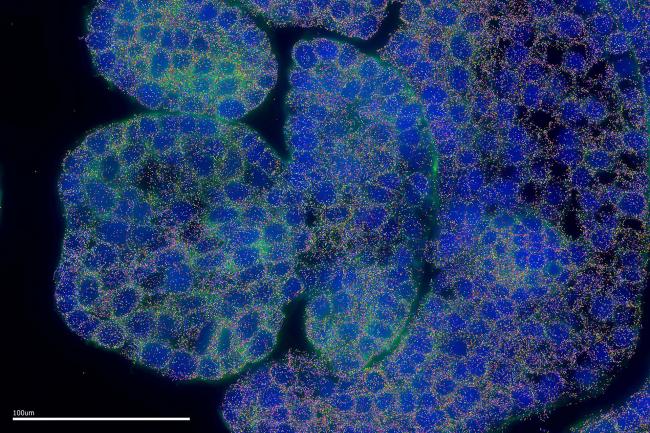
To investigate this, researchers took advantage of advances in single cell technology that enable molecular analysis of cells both individually and within the context of their tissue environment, in situ.
They applied this developing technology to tissue samples of Arabidopsis thaliana, a ‘model’ plant with both male and female reproductive organs.
They found that absisic acid (ABA), a plant hormone, increases in specific plant maternal reproductive tissues when the temperatures drop.
In these cooler conditions this hormone, a plant growth inhibitor, is sent early to the developing seed at a higher rate, helping it to enter dormancy (the ‘sleeping state’ that prevents seeds from growing until environmental conditions are favourable for their growth.)
In warm temperatures, beneficial to successful seed germination, researchers observed that ABA does not peak early but builds steadily, playing less of a role in inducing seed dormancy.
Other non-maternal tissues showed little or no change in ABA with temperature. Further experiments showed that mother plants unable to produce the hormone were unable to induce a dormant response in their seeds.
Together, the experiments reveal a mechanism by which developing seeds receive recent seasonal temperature and nutrient information from the mother plant, in the form of ABA.
The research is a key contribution to the debate about how long it takes plants to adapt to climate change. The message from this study is that, to some extent, they can adapt almost immediately because they are pre-adapted by their mothers to the environment they are dispersed into, using fast-track hormonal messaging.
By highlighting how hormonal transport can influence traits from one generation to the next, the study introduces a vital new tool, alongside genetic and epigenetic inheritance, for researchers and breeders looking to develop climate smart crops.
The research may also help address a big problem in agriculture relating to germinability – a seed's ability to sprout in a timely way that leads to more predictable yields for farmers. Using the knowledge gained in these experiments may enable the development of seeds better adapted to their local environment in which the mother plant grew.

Platform Manager Dr Andrew Goldson in the single-cell labs at Earlham Institute using the BD FACSAria Fusion platform
Professor Steve Penfield, Group Leader at the John Innes Centre and corresponding author of the study, said: “As humans we spend a lot of effort helping children to adapt to their social environment, and we have found a similar pattern in plants. The temperature and nutrient availability the mother plant experiences determines the amount of hormone that they transfer to the seed.
“This shows that plants don’t rely solely on evolution or changes in genetics; they can simply acquire the right amount of hormone to help pre-adapt seeds to the environment that the mother has experienced.”
An important feature of the research was the combined use of the 10X Genomics Chromium X (high-throughput single-cell sequencer) and BD FACSAria™ Fusion (Flow Cytometer) platforms at the Earlham Institute.
Dr Andrew Goldson, co-author of the paper and Manager of the Single-Cell and Spatial Analysis Platform at Earlham Institute, said: “Trying to extract information from a bulk sample is like trying to isolate individual flavours in a fruit smoothie. Single cell technology is a way of isolating those individual flavours; it allows us to get specific data from each cell within a tissue.
"Thanks to funding from BBSRC we've built a robust platform in single-cell and spatial technologies and expertise that's supporting scientists to maximise their research and discoveries. This study required a huge amount of technical expertise and creative problem-solving from the team to adapt the technology to the task."
Previously, the effects of the hormone have been difficult to detect when looking at the whole fruit tissues, but examination of individual tissues with the aid of biosensing equipment revealed sub-cellular activity, not seen previously.
Professor Penfield added: “We were able to see all the cells which the hormone is in, the movement from maternal tissues to seed, and the response of each seed cell to the maternal hormone. We have not been able to see this incredible detail before; the technology and the expertise of colleagues at Earlham Institute has been transformative in this area of research.”
‘Adaptation of seed dormancy to maternal climate occurs via intergenerational transport of abscisic acid’ appears in PNAS.
About the Earlham Institute
The Earlham Institute harnesses data-driven biology to accelerate solutions for health, biodiversity and food security. The Institute combines world-class technology and interdisciplinary expertise across genomics, engineering biology and data science to deliver scientific breakthroughs with economic and social impact.
Based at Norwich Research Park, the Earlham Institute is one of eight institutes strategically funded by BBSRC.
About the John Innes Centre
The John Innes Centre is an independent, international centre of excellence in plant and microbial science. Our mission is to generate knowledge of plants and microbes through innovative, discovery-led research, train scientists for the future, and apply our knowledge of nature’s diversity to support our vision: Healthy Plants, Healthy People, Healthy Planet (HP3).
Together with The Sainsbury Laboratory (TSL) and our funding partners, we are transforming our existing capabilities and supercharging our ability to translate scientific knowledge into practical solutions.
Learn more at: www.jic.ac.uk