Future-proofing crops with synthetic plant chromosomes
From late blight to climate resilience, a pioneering national collaboration is developing synthetic plant chromosomes that could help breeders respond to changing threats to food production.
Global agriculture is under immense pressure from climate change, population growth, environmental degradation and increasing pest and disease threats.
To safeguard food security, farmers urgently need to produce more food, more sustainably, using less land and reduced chemical inputs. While crop breeding offers genetic solutions, conventional methods are very slow, typically taking over 10 years to introduce a single new trait.
Scientists are now turning to engineering biology to reimagine how we future-proof our crops.
As part of a national multidisciplinary collaboration funded by the Advanced Research + Invention Agency’s (ARIA) Synthetic Plants programme, the Earlham Institute is partnering with the John Innes Centre and the University of Manchester to develop synthetic plant artificial chromosomes (synPACs) and introduce them into potato plants.
Instead of introducing individual traits sequentially over successive generations, synthetic chromosomes offer the potential to stack multiple beneficial traits, such as multi-gene disease resistance and enhanced nutritional profiles, and deliver them into plants all at once. This could rapidly speed up the breeding process and provide a more precise, controllable and predictable approach than conventional breeding methods.
Potato is an important UK crop and a major staple food consumed by over a billion people worldwide. However, potato breeding has historically lagged behind major cereal crops like wheat, maize and rice, leaving it vulnerable to threats. For example, late blight can destroy an entire crop within days and causes over $6 billion in annual global losses.
Combining multiple resistance genes via synPACs to target different defence pathways can provide stronger protection and reduce reliance on chemical pesticides.
Dr Melissa Salmon (centre, right) with other members of the ARIA Synthetic Plants programme
Building an artificial chromosome is an enormous task requiring multidisciplinary expertise spanning fundamental plant biology, bioinformatics, engineering, molecular biology, genomics, biochemistry, microbiology, plant transformation, high-throughput screening and synthetic biology.
No single lab has all these capabilities but the collaboration has established a complete end-to-end pipeline covered by all the project partners.
At the Earlham Institute, the design stage focuses on identifying the right regulatory elements that control where and when a gene is expressed. Using multiple copies of the same regulatory element can trigger gene silencing, so the team is creating a toolbox of potato promoters and terminators that can be used to build multi-gene clusters to drive tissue-specific expression. As part of this, Professor Anthony Hall’s group has developed a computational pipeline using existing RNAseq datasets to identify regulatory regions from genes that have precise tissue-specific expression – for example, in the tuber or leaf.
![]()
Having an end-to-end pipeline covered by different partners allows us to advance all stages of the project at the same time. Our combined expertise also expands the breadth of science we can all do, allowing us to engage in much higher impact projects.
![]()
Dr Melissa Salmon, Earlham Biofoundry Operations Manager
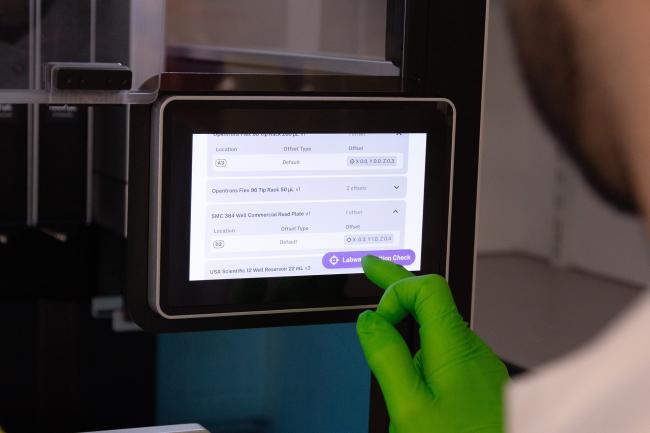
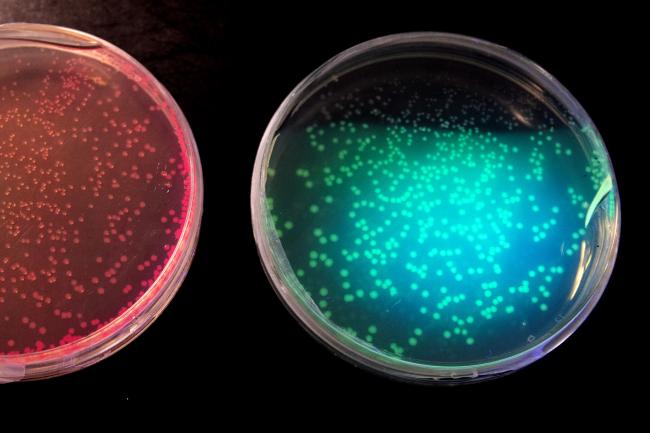
The Earlham Biofoundry leads the characterisation of these potato regulatory elements, working with collaborators to evaluate candidate elements in potato protoplasts and whole plants. The team uses an automated high-throughput DNA assembly pipeline to build hundreds of combinations of regulatory elements into constructs driving the expression of a luminescent reporter gene. This takes advantage of the Biofoundry’s Echo 650 Acoustic Liquid Handler, a pipetteless system that uses sound waves to dispense minute volumes of liquid with exceptional accuracy, eliminating human error.
To assess the strength of different regulatory elements, 2Blades, a US-based non-profit agri-tech company with a research group in Norwich, is testing the reporter constructs in potato protoplasts. 2Blades brings an extensive background in potato disease resistance research, including validated tools for high-throughput screening in protoplasts.
“The synPAC project gives us an opportunity to explore new ways of assembling genes and controlling their expression in potato,” says Dr Kamil Witek, Vice President at 2Blades. “The Earlham Biofoundry brings expertise in DNA assembly and automation that complements our plant biology and disease resistance work, allowing more regulatory elements and gene combinations to be built and compared using consistent workflows.”
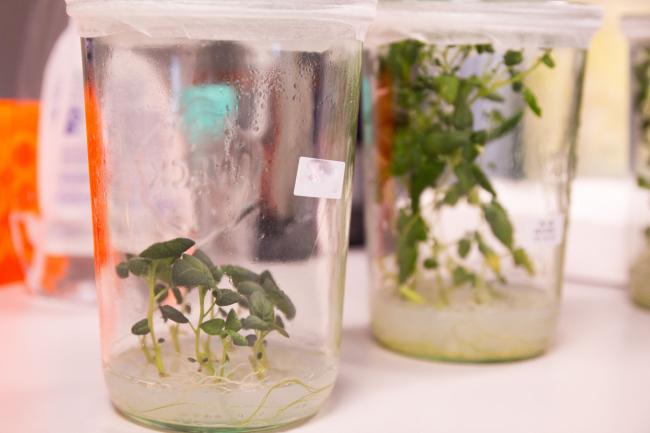
Promising candidates are then passed to the John Innes Centre for transformation into whole plants to validate their tissue-specific expression.
These initial stages of the pipeline are already yielding positive results. The team has identified promising regulatory elements and validated computer predictions of their expression patterns.
![]()
The Earlham Biofoundry brings expertise in DNA assembly and automation that complements our plant biology and disease resistance work, allowing more regulatory elements and gene combinations to be built and compared using consistent workflows.
![]()
Dr Kamil Witek, Vice-President of 2Blades
“It’s really exciting to see that elements we’d predicted to be tuber-specific are strongly expressed only in tubers,” says Dr Melissa Salmon, Earlham Biofoundry Operations Manager. “It proves that our predictive modelling and validation pipeline are working well. We’re getting better at identifying candidates and testing the right combinations. We now have a repeatable pipeline and strong candidates to build our regulatory element toolbox, which will be used to design gene clusters on the artificial chromosome.”
The next stage of the project will involve assembling the artificial chromosome. Building large lengths of plant DNA is particularly challenging due to the highly repetitive nature of plant genomic sequences. The synPAC will first be assembled in yeast by Professor Patrick Yizhi Cai’s group at the University of Manchester, drawing on their extensive expertise in building synthetic yeast chromosomes alongside that of Dr Conrad Nieduszynski’s team at Earlham Institute. To ensure these large constructs remain stable during cell division, the Manchester team is also designing an artificial centromere capable of functioning in both yeast and plant cells.
Finally, after assembling the synthetic chromosome, the team will deliver it into potato protoplasts. In a joint effort across the Earlham Institute, the University of Manchester and the John Innes Centre, researchers will fuse yeast host cells containing the artificial chromosome directly with potato protoplasts, before using them to regenerate whole plants.
Dr Melissa Salmon, left, Biofoundry Operations Manager, with Dr Carolina Grandellis, right, Head of the Earlham Biofoundry.
“Having an end-to-end pipeline covered by different partners allows us to advance all stages of the project at the same time,” explains Melissa. “Our combined expertise also expands the breadth of science we can all do, allowing us to engage in much higher impact projects.”
The project’s success relies on collaborative co-design, with each partner contributing specialist intellectual input. This builds on long-standing relationships between the partners on Norwich Research Park. With the Earlham Institute, John Innes Centre and 2Blades all based close together in Norwich, the teams can meet regularly face-to-face, share ideas and address challenges as they arise.
As one of the few ARIA projects delivered by an all-UK consortium, it showcases national strengths and leadership in engineering biology. By bringing together complementary capabilities, it illustrates what can be achieved with strategic investment to accelerate the development of new techniques for plant synthetic genomics.
Synthetic potato chromosomes could enable breeders to rapidly engineer beneficial traits to directly address the needs of farmers under changing environmental pressures. In phase two of the project, the team plans to translate the tools to other staple crops. This could eventually lay the groundwork to construct whole synthetic plant genomes. Meanwhile, the individual techniques being developed will offer standalone value across plant research and biotechnology. For example, synPACs or other large DNA assemblies could provide new platforms for the sustainable plant-based biomanufacturing of essential nutrients and bioactive compounds. Ultimately, the project should provide both immediate tools for plant research and the long-term foundations to drive green manufacturing, build resilience into future crops and secure global food supplies.
Scientists at the Earlham Institute are integrating engineering biology, genomics, and AI to accelerate the scale and impact of biological design.